A FICA delegation composed of Co-Chair Dr. Herman Verbist and Mira Vats-Fournier, FICA Fellow, attended the 83rd session of UNCITRAL Working Group II (Dispute Settlement) in New York in the week of 12-16 February 2026.
During the session of UNCITRAL Working Group II, a “Colloquium on the Use of Artificial Intelligence in Dispute Resolution and Remote Hearings in Arbitration and Mediation” was organized and amendments to the UNCITRAL Model Law on International Commercial Arbitration were adopted in regard to the recognition and enforcement of arbitral awards in electronic form and amendments to the UNCITRAL Arbitration Rules in regard to electronic notices of arbitration.
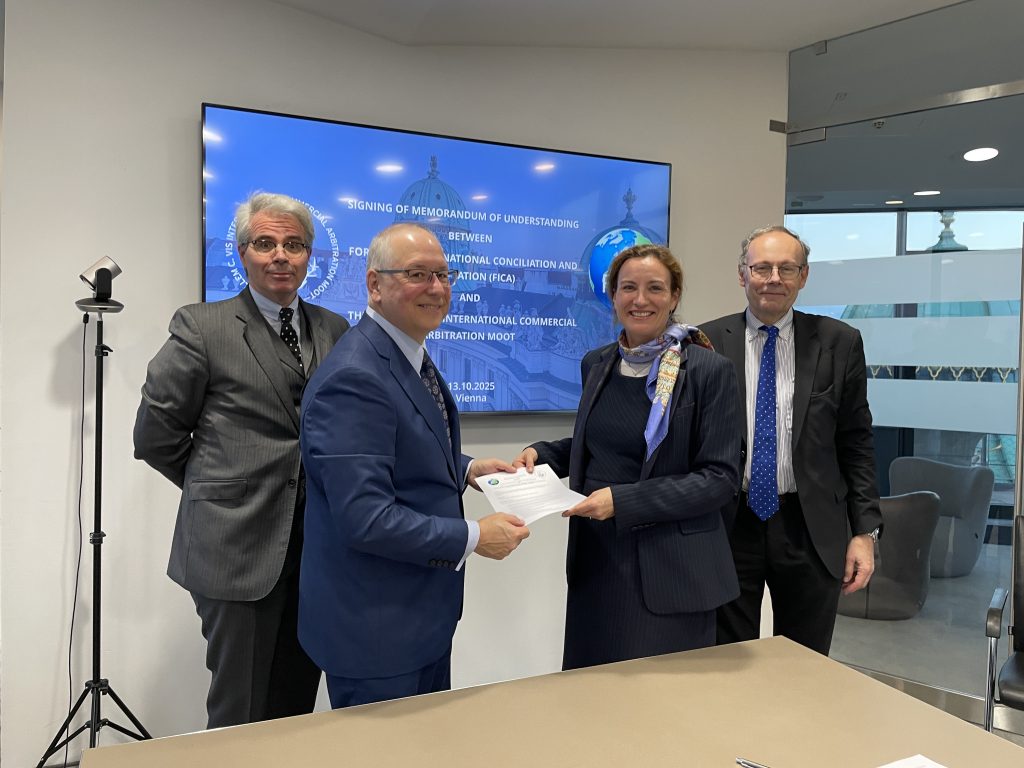
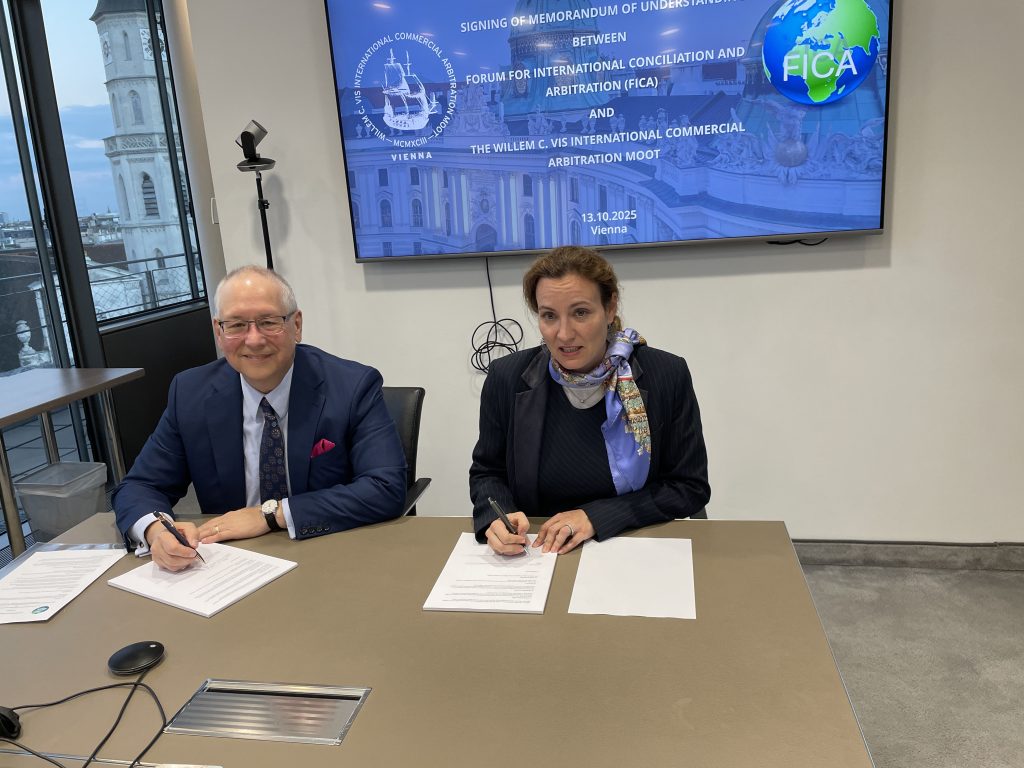
On 13 October 2025, the Forum for International Conciliation and Arbitration (FICA) signed a landmark Memorandum of Understanding in Vienna with the Association for the Organization and Promotion of the Willem C. Vis International Commercial Arbitration Moot (the Vis Moot).
The Agreement was signed by Alan M. Anderson, Board Member and Secretary of FICA, on behalf of FICA, and by Patrizia Netal, one of the directors of the Vis Moot, on behalf of the Vis Moot. FICA Co-chair Herman Verbist and Board Member Constantin Eschlboeck also attended the event on behalf of FICA, which was held at the law firm Knoetzl in Vienna.
With this Memorandum of Understanding, FICA joins a number of international arbitration organizations and institutions as supporters of the Vis International Commercial Arbitration Moot Competition, which is organized every year in Vienna and in which thousands of law students from universities around the world participate.
FICA will be supporting the Vis Moot for at least the next five years. The funds FICA will donate will be used for the benefit of competitors and students, particularly those from developing/near-developed countries, to attend and compete in the Vis Moot, and to reduce the costs to participants generally. The funds came to FICA from the estate of the late D. Mark Cato, an internationally recognized arbitrator and author, through the efforts of FICA’s late chair and founder, Mr. Ben Beaumont.
For FICA, this new milestone confirms its growing role in promoting arbitration and conciliation across borders, particularly in developing/near-developed countries.
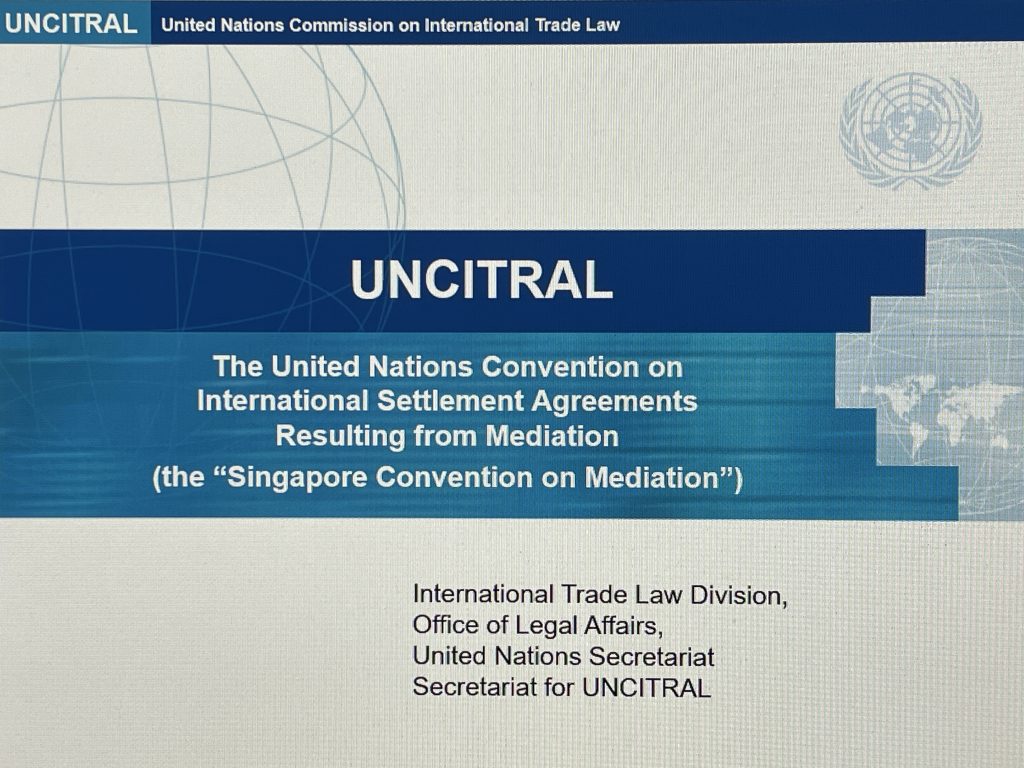
On 16 December 2025, Herman Verbist (Co-chair of FICA) was moderator of a panel discussion on the topic “Position of the European Union towards the Singapore Convention on Mediation” with the following speakers:
Dr. Judith Knieper (Legal Officer, United Nations Commission on International Trade Law (UNCITRAL), Vienna; Secretary of Working Group II on Dispute Settlement and responsible for Mediation);
Mr. Ales Zalar (Director at the Patent Mediation and Arbitration Centre (PMAC) of the Unified Patent Court, Ljubljana; Former Minister of Justice of Slovenia)
Dr. Norel Rosner (EU Commission, DG Justice and Consumers, Brussels).
19 November 2025 Report by Yuan Fang, Washington University in St. Louis
Overview
The sixty-ninth session of UNCITRAL Working Group IV (Electronic Commerce) was held in Vienna, Austria on October 20-24, 2025. The session, with broad participation from Member and observer States, international organizations, and NGOs, focused primarily on the ongoing effort to create harmonized provisions governing cross-border data provision. The Working Group considered the fourth revision of the draft default rules for data provision contract, primarily examining conceptual issues, article-by-article drafting questions (with intensive discussion devoted to Articles 1-9 of the draft rules), and next steps toward finalizing a normative text.
II. Preliminary Matters
The Working Group picked up discussions from its previous sessions on the legal distinction between active and passive data provision. Passive provision refers to situations where data is generated automatically through the use of a device or service without the data provider actively supplying it. Delegates widely supported including passive data provision within the scope of the rules, but applying lighter obligations to data providers given their limited control over data characteristics and transmission.
A draft definition of passive provision was introduced, outlining factors such as: (1) the data recipient accessing data through means it provides; (2) the object of the transaction being access to data generated through the provider’s activities; (3) no data quality or quantity undertaking by the provider; (4) lack of provider responsibility for technical systems collecting and transmitting data; and (5) lack of meaningful influence over contract terms. Delegates generally agreed that the definition should operate as a closed list, refined further in subsequent drafts.
Delegates also emphasized distinguishing “authorization” to access data (a contractual concept) from “consent” under privacy and data protection regimes, noting that the former does not make a person a contractual party merely by agreeing to data processing.
III. Article-by-Article Review
Article 1: Definitions
The definition of “data” may require refinement in various language versions to ensure it is understood as a record or representation, not the underlying information itself. On the definition of “use” of data, delegates questioned whether listing specific operations (e.g., storing, combining, modifying) was useful, and debated adding terms such as generating, saving, disclosing, or analyzing data. Concerns were raised that referencing “disclosing” could introduce personal-data complications. Some suggested deleting the definition altogether and addressing usage concepts solely in Article 9.
Article 2: Scope of Application
Debate centered on whether to exclude contracts involving software, since boundaries between data and software are increasingly blurred, especially with AI. Some States argued for excluding software supply contracts to avoid conflicts with well-established legal frameworks. Others countered that software-as-a-service and cloud services often involve substantial data provision components. A broader concept—excluding contracts involving functional data and representative data—garnered support. Delegates stressed, however, that any exclusions must clearly maintain the rules’ focus on transactions where the data itself is the contractual object.
There was extensive debate about consumer contracts. Some argued that excluding consumer transactions was outdated, especially given the prevalence of passive data flows from consumer devices. Others highlighted the difficulty of harmonizing consumer protection law across States. Delegates decided to defer a final decision until the overall structure of the rules becomes clearer.
Article 3: Party Autonomy
Delegates noted a risk that the current wording might allow parties to derogate from mandatory laws, including those preserved in Article 2(4). The text will likely be adjusted so that contractual freedom explicitly remains subject to mandatory law and applies only to substantive default rules.
Article 4: Interpretation
Delegates supported including guidance on general principles underlying the rules, such as good faith and equity. The explanatory note may also integrate considerations about the unique traits of data and data transactions.
Article 5: Obligation to Provide Data
The relationship between Article 5 (what is provided) and Article 6 (how) was clarified. Delegates debated how to fit passive provision into the framework. While some suggested modifying the operative rule to “allow collection” rather than “make available,” others argued that “making data available” is sufficiently broad if clarified in an explanatory note. Delegates agreed to reinsert language requiring providers to supply information necessary to access the data (e.g., passwords).
Article 6: Mode of Provision of Data
A key outcome was the development of a new paragraph addressing passive data provision. This paragraph states that, in passive scenarios, the data provider’s sole obligation is to allow, and not impede, access to the data or the data source using means supplied by the recipient. Delegates supported retaining references to “data sources,” given the centrality of connected devices. Concerns about data security, integrity, and system functionality were discussed, with the understanding that these issues may be addressed through interactions among Articles 6, 8, mandatory laws, and the duty to cooperate. Article 6 may undergo repositioning or redrafting.
Article 7: Timing of Provision of Data
The Working Group revisited whether “without undue delay” or “within a reasonable time” should be the default standard. While “reasonable time” aligns with the CISG, “without undue delay” was considered more fitting for instantaneous digital environments. Delegates determined that setting a fixed starting point (as in CISG Article 33) may not suit data transactions.
Article 8: Conformity of Data
Delegates agreed to retain paragraph 1, while proposals for paragraph 2 focused on whether conformity should reflect objective standards, recipient purposes, or representations. Paragraph 4, listing characteristics relevant to assessing conformity, was refined by adding “availability” and references to “origin” and “coherence.” Concerns were raised that excessively long lists may be counterproductive. Delegates broadly agreed that conformity rules should not apply to passive provision of data.
Article 9: Use of Data
The chapeau and paragraph (a) were retained, stressing that contractual agreements cannot authorize unlawful use. A new proposed default rule would require the recipient to ensure its data usage does not infringe third-party or provider rights. Challenges remain regarding data deletion obligations, particularly when derived or trained-model data is involved.
IV. Next Steps
There was broad consensus to avoid a convention at this stage. Delegations were split between developing a model law or a legislative guide, ultimately agreeing that the next draft would consist of model legislative provisions with explanatory notes, with a final decision to follow. Completion in 2026 depends on progress at the next session and Commission scheduling.
FICA and Indonesia Dispute Board delegations at the Cooperation Agreement signing in Brussels, September 2025
On 16 September 2025, the Forum for International Conciliation and Arbitration (FICA) signed a landmark Cooperation Agreement in Brussels with the Indonesia Dispute Board (IDB).
This agreement represents FICA’s first international cooperation of its kind, while for the IDB it marks the 34th agreement since its establishment in 2021.
A Milestone for FICA and IDB
The signing ceremony was attended on behalf of FICA by Co-Chairs Herman Verbist and Jeffrey Chan, and on behalf of the IDB by its President, Prof. Sabela Gayo, accompanied by a seven-person delegation.
For FICA, this milestone underscores its growing role in promoting conciliation, mediation, arbitration, and dispute resolution across borders.
Herman Verbist and a representative of the IDB delegation formalize the Cooperation Agreement in Brussels
About the Indonesia Dispute Board
The Indonesia Dispute Board is one of the most active institutions in the field of alternative dispute resolution (ADR). Since its founding in 2021, it has signed more than 30 cooperation agreements with organizations worldwide.
Today, the IDB counts over 5,000 members, including:
Mediators
Adjudicators
Conciliators
Arbitrators
Dispute board members
It also provides rules and frameworks for these various dispute resolution methods.
Strengthening International Arbitration and Conciliation
Through this Cooperation Agreement, FICA aims to strengthen ties with Indonesia’s dispute resolution community, contributing to the growth of conciliation and arbitration both in Indonesia and internationally.
Plaque presentation to commemorate the signing of the Cooperation Agreement in Brussels, 16 September 2025
Herman Verbist, Co-chair of FICA, attended for FICA the 81th session of UNCITRAL Working Group II (Dispute Settlement) in New York in the week of 3-7 February 2025 where the topic of the recognition and enforcement of electronic arbitral awards was further discussed.
Not only a proposed recommendation regarding the interpretation of the New York Convention, but also some amendments to the UNCITRAL Model Law on International Commercial Arbitration, as well as proposed amendments to the UNCITRAL Arbitration Rules and to the Model arbitration clause in regard to the recognition and enforcement of electronic arbitral awards were discussed. The Working Group requested the Secretariat to prepare revised versions of these proposals for further discussion.
FICA was pleased to participate in the discussions in UNCITRAL Working Group II leading to the UNCITRAL Model Clauses on Specialized Express Dispute Resolution (“SPEDR”) including a Model clause on Adjudication.
At the outset of the discussion in UNCITRAL Working Group II, FICA-DACABI has prepared in 2021 a proposal for a Model Law on International Commercial Adjudication which it has shared with UNCITRAL and various delegations of UNCITRAL Working Group II.
Although there was no support to elaborate a Model Law on Adjudication, FICA is pleased that the topic of “adjudication” has been discussed in the framework of the SPEDR Model clauses and that this has led now to an UNCITRAL Model clause on Adjudication.
This will undoubtedly lead to making Adjudication better known as an alternative method to settle commercial disputes in different sectors.
On 30 September 2024, during its 80th session in Vienna, UNCITRAL Working Group II concluded its work in this field by adopting “Explanatory Notes” which will provide further explanations to the UNCITRAL “SPEDR” Model clauses.
Submitted to UNCITRAL Working Group II by FICA (Forum for International Conciliation and Arbitration) proposal for Model Law on Adjudication and proposal for Explanatory Notes prepared by DACABI (Dispute Avoidance, Conciliation and Adjudication Board Institute)
We use cookies on our website to give you the most relevant experience by remembering your preferences and repeat visits. By clicking “Accept All”, you consent to the use of ALL the cookies. However, you may visit "Cookie Settings" to provide a controlled consent.
This website uses cookies to improve your experience while you navigate through the website. Out of these, the cookies that are categorized as necessary are stored on your browser as they are essential for the working of basic functionalities of the website. We also use third-party cookies that help us analyze and understand how you use this website. These cookies will be stored in your browser only with your consent. You also have the option to opt-out of these cookies. But opting out of some of these cookies may affect your browsing experience.
Necessary cookies are absolutely essential for the website to function properly. These cookies ensure basic functionalities and security features of the website, anonymously.
Cookie
Duration
Description
cookielawinfo-checkbox-analytics
11 months
This cookie is set by GDPR Cookie Consent plugin. The cookie is used to store the user consent for the cookies in the category "Analytics".
cookielawinfo-checkbox-functional
11 months
The cookie is set by GDPR cookie consent to record the user consent for the cookies in the category "Functional".
cookielawinfo-checkbox-necessary
11 months
This cookie is set by GDPR Cookie Consent plugin. The cookies is used to store the user consent for the cookies in the category "Necessary".
cookielawinfo-checkbox-others
11 months
This cookie is set by GDPR Cookie Consent plugin. The cookie is used to store the user consent for the cookies in the category "Other.
cookielawinfo-checkbox-performance
11 months
This cookie is set by GDPR Cookie Consent plugin. The cookie is used to store the user consent for the cookies in the category "Performance".
viewed_cookie_policy
11 months
The cookie is set by the GDPR Cookie Consent plugin and is used to store whether or not user has consented to the use of cookies. It does not store any personal data.
Functional cookies help to perform certain functionalities like sharing the content of the website on social media platforms, collect feedbacks, and other third-party features.
Performance cookies are used to understand and analyze the key performance indexes of the website which helps in delivering a better user experience for the visitors.
Analytical cookies are used to understand how visitors interact with the website. These cookies help provide information on metrics the number of visitors, bounce rate, traffic source, etc.
Advertisement cookies are used to provide visitors with relevant ads and marketing campaigns. These cookies track visitors across websites and collect information to provide customized ads.